
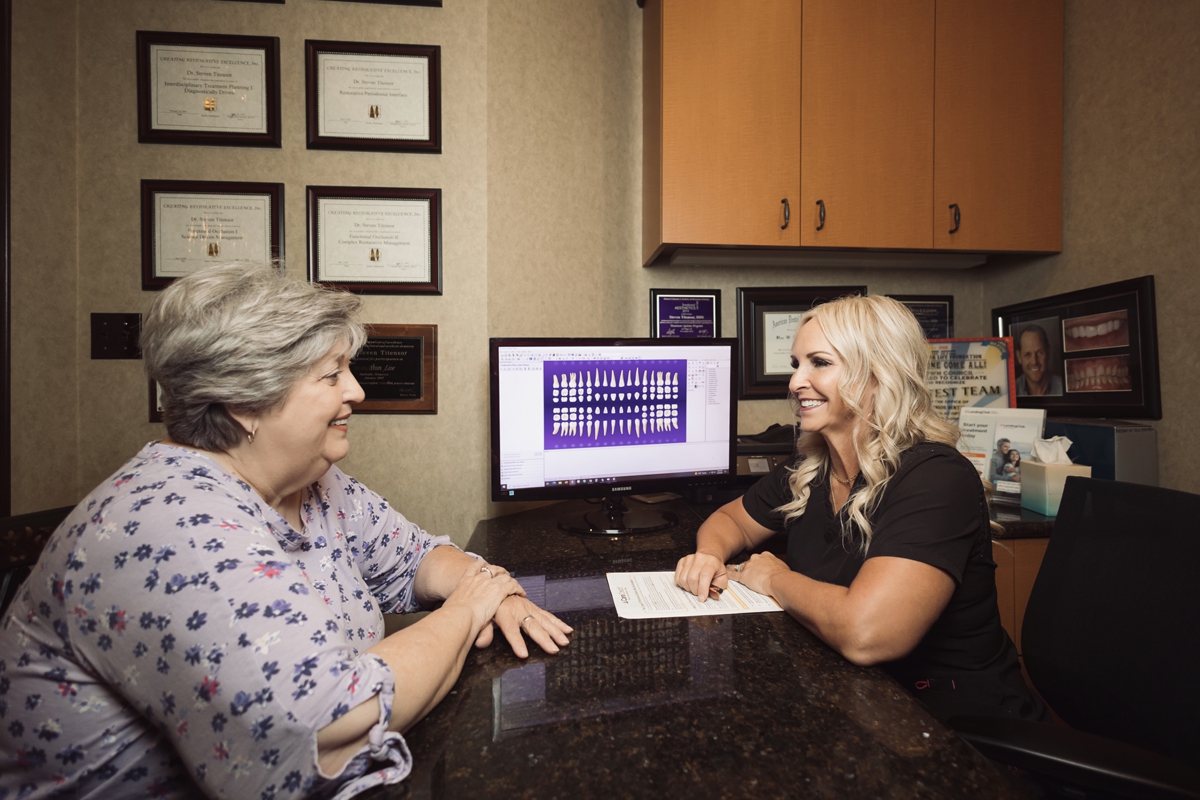

Whether you’ve lost a single tooth, several teeth, or need to replace all of your teeth, dental implants in Flower Mound, TX from Titensor Dental may be the right choice for you. With a set of dental implants from our team, you can restore your smile, eat your favorite foods again, and even prevent further complications related to tooth loss, such as bone resorption and teeth shifting.
But what type of dental implant might be right for you? Every patient is different, after all. That’s why Dr. Brett Steven Titensor and Dr. Joseph Jackson Mann will discuss all of your options for implant dentistry during your consultation at our office. We’ll help you choose the right type of dental implant based on your oral health, number of missing teeth, budget, and more.
Want a sneak peek? In this guide, we’ll get into the basics of how dental implants work, discuss the different types that are available, and even compare dental implants to other common types of tooth replacements like dentures and bridges. This ensures that you’ll know a little bit more about your options before your first visit to Titensor Dental.
What Are Dental Implants? Understanding The Basics
A dental implant is a small, screw-shaped piece of titanium. Each implant is designed to be surgically placed into your mouth in the area where you’ve lost a tooth, based on a treatment plan that’s been carefully crafted by Dr. Titensor or Dr. Jackson.
Once it’s in place, the dental implant heals and bonds to the jawbone in a process called “osseointegration.” This is why titanium is used, since it’s one of the only metals that has the ability to bond to natural bone permanently.
After it integrates with your jawbone, the implant essentially functions as an artificial tooth root. This means that it can be used to support a variety of different restorations.
The most common type is a single-tooth restoration, where one implant supports a single crown (false tooth) to replace one missing tooth. However, multiple implants can also be used to support a bridge or even a full set of teeth.
The Benefits of Choosing Dental Implants
Before we get into the details about the different types of implants that are available, it’s important to understand what sets them apart from other tooth restoration options like bridges and dentures. Wondering what makes dental implants so special? Here are just a few benefits you’ll enjoy if you choose implant dentistry from the team at Titensor Dental.
- Completely natural look and feel – Once it heals, your implant will be permanently bonded to your jawbone. This means that it will be very stable and will never shift or move, unlike dentures. Dental implants look and feel more natural than any other type of tooth replacement.
- Long-lasting results – If you take good care of your dental implants, they will likely last for the rest of your life. You may need to replace the implant restoration (such as a bridge or crown) every 10-20 years or so, but the implant itself will typically never fail as long as it stays healthy.
- Easy to care for – Single-tooth implants can be treated just like natural teeth. Brush twice a day, floss once daily, and see Dr. Brett or Dr. Jackson for a checkup every six months. Other restorations like implant dentures or implant bridges require a little bit more care, but are still low-maintenance compared to alternatives like traditional dentures.
- Restores your oral function and confidence, too – With dental implants, you’ll be able to permanently overcome the negative effects of tooth loss. You’ll be able to speak clearly, eat all of your favorite foods, smile proudly, and know that your smile will stay healthy for years and decades to come.
- Stimulates and protects the jawbone – This is one of the most unique benefits of dental implants. Unlike traditional dentures and bridges, the implant doesn’t just sit on top of your gums and jawbone. Since it’s integrated into your natural oral structure, it stimulates the jawbone when you bite and chew. In turn, this prevents bone loss in the area, which can be a big issue with other types of tooth replacement.
Explaining The Types Of Dental Implants
Dental implants aren’t “one size fits all.” There are a few different types of implants and restorations that you may want to consider as you decide on the best way to replace your missing teeth. Here’s a quick overview of the most common dental implant options used in dentistry today:
Single-tooth implants
Single-tooth implants are the simplest and most common type of implant. They consist of a single implant “post” that’s surgically implanted into your jawbone. Over time, the implant heals and bonds with the jaw.
Then, when it’s fully healed, a dental crown (false tooth) is made and attached to the implant with an abutment. This fully replaces a single missing tooth. Single-tooth implants are a good option if you’re missing just one tooth, or if you have a few missing teeth throughout different parts of your mouth and your other teeth are still healthy and strong.
Implant-supported bridges
An implant-supported bridge is quite similar to a traditional bridge. However, instead of attaching to healthy “abutment teeth” with crowns, this type of bridge is anchored securely to two dental implants. This means there is no need to trim the healthy teeth next to the gap in your smile.
Implant bridges are ideal for patients who are missing three, four, or even more teeth in a row. They are made of durable and lifelike ceramic materials. Implant bridges are easy to maintain and also have a longer lifespan than traditional bridges, in most cases.
Full-mouth implants
Full-mouth implants are an alternative to traditional full-mouth dentures. They typically use a series of 4-6 implants in the upper arch, lower arch, or both arches of the mouth, depending on your specific needs.
Rather than being held in place with friction like traditional dentures, full-mouth implants use a special type of dentures that snap directly onto the implants. Depending on the type, these dentures may be removable (sometimes called “snap-in dentures") or may be fixed in place and only removable by a dentist (All-On-4).
Full-mouth implants, similarly to traditional dentures, are usually only recommended for patients who are missing most or all of their natural teeth. This is because any remaining teeth must be extracted before the full-mouth implant process can begin.
Mini implants
As the name suggests, mini dental implants are only about half the size of traditional dental implants. Because of this, they are less invasive. They also require less healthy bone structure compared to traditional implants. This means that mini implants are a more suitable choice for patients who may have experienced mild to moderate bone loss in their jaws.
A set of 6-10 mini implants is usually required to hold a set of upper or lower implant-retained dentures. They can also be used for implant bridges, but are not typically used for single-tooth implants, since one mini implant is not as strong or stable as a single traditional implant.
Zygomatic implants
Zygomatic implants are a specialized type of dental implant used for restoring the upper arch of teeth. These implants are very long, which allows them to be secured in the zygomatic arch (cheekbone) instead of the jawbone.
This eliminates the need for bone grafting and means that zygomatic implants can be used even in cases where patients have experienced severe bone loss. However, the procedure is more invasive and complex, so it’s not the best option for every patient.
Understanding The Cost Of Dental Implants
The cost of dental implants varies wildly. A single implant may cost only a few thousand dollars, while a full mouth of implants may cost tens of thousands of dollars. It all depends on a few different factors, such as:
- Type of implant – Single-tooth implants are the simplest and fastest, and are usually the most affordable. Implant-supported bridges and implant dentures are more complex and costly.
- Number of implants – Generally speaking, the more teeth you need to have replaced with dental implants, the more expensive your treatment plan will be. Replacing just one or two teeth will always be cheaper than opting for full-mouth reconstruction with implant dentures.
- Preparatory procedures – Some patients may need additional treatments like tooth extractions, alveoloplasty (bone ridge smoothing and reshaping), bone grafting, or sinus lifts. These all add up to a higher overall price.
At Titensor Dental, we are committed to transparency when it comes to dental implant costs. If you choose to get implants at our office in Flower Mound, TX, we will provide you with an accurate estimate and ensure that there are no hidden fees or other surprises.
We also offer payment plans and financing options for qualifying patients. This lets you split the cost of treatment into manageable monthly installments. You’ll be able to get the smile you deserve now, and pay for your care over time!
Understanding Your Other Tooth Replacement Options
Dental implants may not always be the best choice for every patient. Whether it’s due to your oral health, budget, or personal preferences, there are some alternatives to implants that you may want to discuss with Dr. Titensor or Dr. Jackson during your visit.
Dental bridges
Dental bridges are a good option for replacing a row of multiple missing teeth. They use two crowns that attach to healthy teeth (known as “abutment teeth) on either side of the gap. Then, one or more false teeth (pontics) are used to “bridge” the gap and restore the missing teeth.
Typically made of a porcelain and metal framework, bridges are lifelike, durable, and feel very similar to natural teeth. They also do not require major dental surgery, so they are less invasive than traditional dental implants.
Dental bridges can also be crafted more quickly, so you can restore your smile in just 2-3 visits over a period of about a month. Bridges are usually covered by insurance plans up to applicable limits, too, which makes them a budget-friendly option.
The biggest drawback of dental bridges is that they require healthy natural tooth structure to be removed from your teeth. They are also not as durable or long-lasting as dental implants, and are a little bit harder to clean and maintain.
Full and partial dentures
If you’d prefer to avoid getting dental implants, dentures are a reliable, cost-effective, and natural-looking way to replace missing teeth. There are two primary types of dentures:
- Partial dentures – Partial dentures consist of one or more false teeth in a metal framework that clips onto your healthy teeth. This holds them in place, restoring your smile and your bite.
- Full dentures – Full dentures consist of a full arch of upper or lower teeth in an acrylic framework. They are used when you’ve lost most or all of your natural teeth, since you must have any remaining teeth pulled to be fitted for dentures.
Dentures can usually be fitted in about a month, so they offer faster results than implants. They also are the most affordable way to replace missing teeth, especially if you have dental insurance that will cover part of the cost.
However, dentures require you to make some changes to your diet and lifestyle, and they may still sometimes slip and slide around your mouth when you chew or speak. They can be uncomfortable if they don’t fit properly, and dentures also tend to wear out and change shape over time.
Dentures also require lots of special care, such as rinsing your dentures after meals and soaking them overnight to give your gums a rest. They are also less durable than implants, and require replacement or relining as often as every 5-10 years.
Finding the Right Implant For You – What’s The Best Option?
Wondering what type of dental implants may be recommended to you by our team? Here’s a general overview of when we’ll recommend each type of implant at Titensor Dental:
- One, two, or several missing teeth – If you’re just missing a couple of teeth in different parts of your mouth and your other teeth are healthy, we will typically recommend single-tooth implants.
- Multiple missing teeth in a row – If you’re missing a row of three, four, or more teeth, implant-supported dental bridges are the best way to replace your teeth and restore your smile.
- Widespread tooth loss and damage – If you have extensive oral health issues and most (or all) of your teeth are damaged or missing, full-mouth reconstruction with implant-supported dentures is usually the best path for restoring your smile and bite.
The best way to find out which type of dental implant is right for you is with a consultation at Titensor Dental. Together, you and Dr. Jackson or Dr. Titensor can discuss all of your options and determine what’s right for your oral health, budget, and lifestyle.
Frequently Asked Questions
- What is the lifespan of dental implants? The implant itself (the titanium post) will usually last 30+ years, and many patients keep their implants for the rest of their lives. Implant restorations like crowns, bridges, and dentures are also durable, but may need to be replaced every 10-20 years or so as they wear out.
- How painful is getting dental implants? We use numbing to keep you comfortable during your treatment, and we offer a variety of sedation options at Titensor Dental, too. Patients typically compare the discomfort to that of a tooth extraction. Pain usually peaks within a day or two of the procedure and then begins to fade as you heal. Dr. Titensor and Dr. Jackson will provide you with comprehensive instructions on how to manage your discomfort and ensure a swift recovery.
- Can anyone get dental implants? To get dental implants, your mouth must be healthy, free of any other chronic oral health issues (cavities, infected teeth, gum disease, etc.), and you must have adequate bone structure to support the implant. If your mouth is not healthy enough for implants, you may need additional treatments like root canal therapy, periodontal cleanings, and bone grafting to prepare for dental implant surgery.
Explore Your Implant Options At Titensor Dental
We hope this guide has helped you learn a little bit more about your options for restoring your smile with dental implants in Flower Mound, TX. Whether you’re missing one, several, or most of your teeth, dental implants are the best way to permanently restore your smile.
If you’re ready to smile with confidence, eat all of your favorite foods, and enjoy a permanent tooth replacement that fits into your lifestyle, Dr. Titensor and Dr. Jackson are here to help. Give us a call at (972) 355-9545 or contact us online to schedule your consultation and find out if dental implants from Titensor Dental are right for you.